
Rhine low water: new barge surcharges from 1 November
The Rhine has been at or near record lows this autumn, and barge capacity in and out of Germany is tight. Hapag-Lloyd has told customers that revised low-water surcharges on Rhine cargo apply from 1 November 2026, for imports and exports, until further notice. If your cargo moves by barge between Rotterdam or Antwerp and inland Germany, Switzerland or eastern France, expect a higher bill and less certainty on dates.
What’s happening on the river
- The Kaub gauge, near Koblenz, is the river’s main shallow point. It fell to 0 cm late on 28 September, according to German waterways agency data reported by Reuters. The agency said September’s record readings had not yet been verified.
- The gauge reading is not the depth of the channel: the riverbed is more than a metre deeper than the gauge reading. But the lower the reading, the less each barge can carry. Contargo says that at 135 cm a 500 TEU barge can only be half loaded, and at 75 cm it takes four barges to move the same tonnage.
- On 15 October, The Loadstar reported barges around Duisburg-Ruhrort running at about two-thirds of normal capacity, with much smaller loads further upstream. Some services above Kaub were suspended, and cargo was moving to rail and truck. The hardest-hit areas were southern Germany, Switzerland and the Upper Rhine.
- Contargo’s published readings show Kaub at 19 cm on 22 October, recovering to 56 cm on 27 October. That is better, but still well below the 80 cm line that matters for guarantees (see below).
The surcharges
- Hapag-Lloyd’s surcharge depends on four gauges: Kaub, Cologne, Duisburg-Ruhrort and Emmerich.
- For terminals south of Koblenz, its Kaub table starts at €40 per 20 ft and €50 per 40 ft container at 131–150 cm. At 51–60 cm, where Kaub stood on 27 October, it is €550 and €645. The lowest band, from 25 cm, is €1,350 per container. Below the levels in the tables, the charge is agreed case by case.
- Hapag-Lloyd says transport cannot be guaranteed at or below 80 cm at Kaub, 105 cm at Cologne, 180 cm at Duisburg-Ruhrort or 30 cm at Emmerich.
- Barge operator Contargo publishes its own table. At those same levels its surcharge becomes “by agreement”, and it has warned it may have to suspend regular services to the Upper Rhine, Middle Rhine and Rhine-Main regions.
What it means for your next shipment
- Containers on a barge leg: budget for the surcharge, and ask your forwarder which gauge and band applies. Contargo, for example, uses the 5 a.m. reading on the day the barge departs. Ask too whether your boxes will go by rail or truck instead.
- Book alternatives early: SeasC4U told The Loadstar that replacement truck capacity can take up to two weeks to find, and rail may need up to six weeks’ notice. Even after the water comes back, schedules may take up to 10 days to settle.
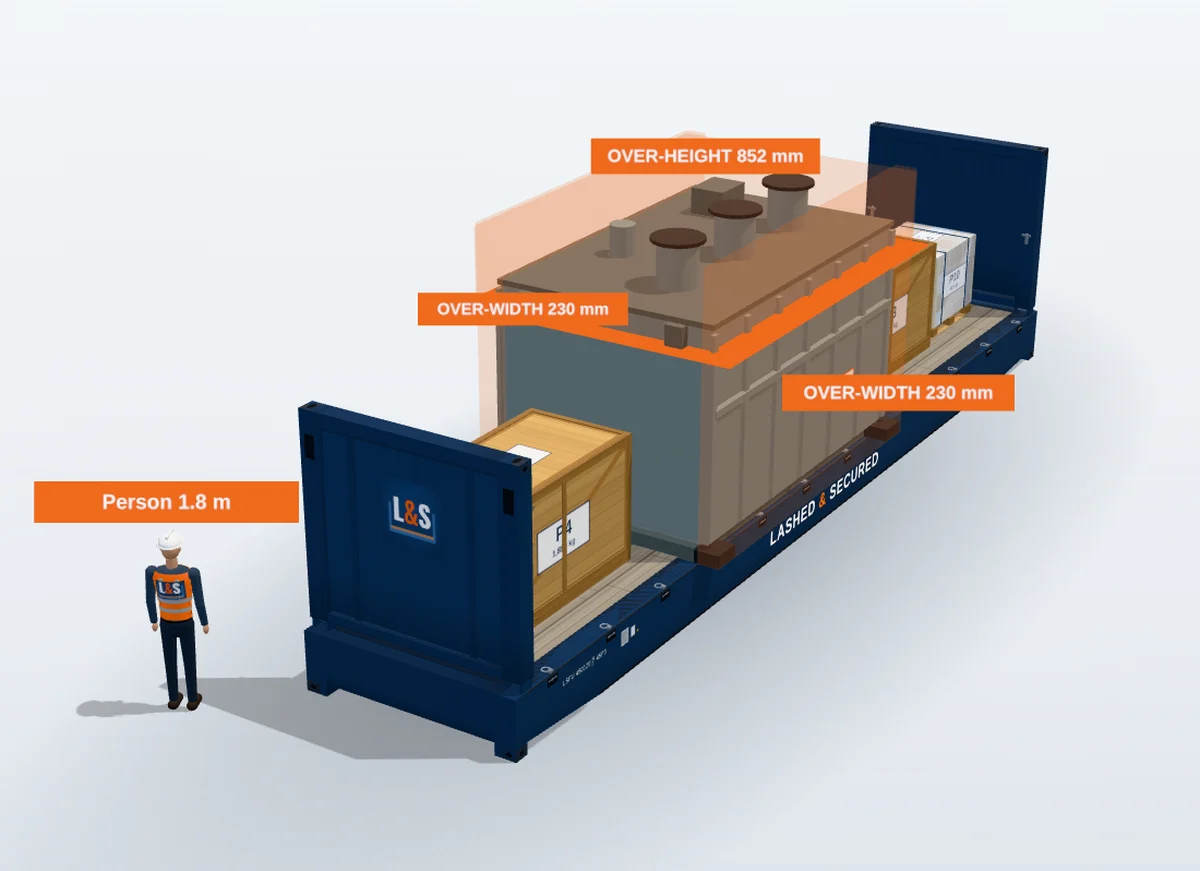
- Heavy and out-of-gauge pieces: for the biggest pieces, the river is often the only practical route. Part-loaded barges and suspended services upstream mean fewer options. Decide early whether to wait for water, use a different port, or plan a road move. Road permits and route surveys for abnormal loads take time.
- Who pays: check your contract and Incoterm. Whoever arranges the inland leg usually carries the surcharge. See our Incoterms guide.
- Check before you book: levels change day to day. The German waterways agency publishes current gauge readings on ELWIS.
Sources
- Hapag-Lloyd, Rhine River: Additional Low Water Surcharge Levels Introduced, 25 Sep 2026. Read the source
- The Loadstar, Low Rhine water level driving barge cargo to capacity-strained road and rail, 15 Oct 2026. Read the source
- Baird Maritime (Reuters), Low Rhine water levels disrupt shipping, Kaub gauge drops to zero, 29 Sep 2026. Read the source
- Contargo, Low water surcharge information for container transport, with water-level history, checked 27 Oct 2026. Read the source